

How to Choose a HEPA Vacuum for Allergies and Pets
, by Editorial Team, 17 min reading time
, by Editorial Team, 17 min reading time
Picking a hepa vacuum for allergies or pet hair? Learn which true HEPA filters and sealed systems trap fine dust, then find the model that fits your home.
Quick Summary
Choose a HEPA vacuum by first confirming the filter is true HEPA, meaning it captures at least 99.97% of particles at 0.3 microns. Then check that the whole machine is sealed, since a loose seal can let dirty air bypass the filter. Finally, match the vacuum type to your floors and compare the annual cost of filters and bags.
Last Updated: November 2, 2026
If you have allergies or pets, a HEPA vacuum can make your home noticeably cleaner, but only if the filter is real. Many shoppers pay premium prices for machines that never trap the particles that matter.
A HEPA filter is a mechanical filter designed to capture very small airborne particles. The name comes from "high-efficiency particulate air." Dust, pet dander, pollen, and many allergens are small enough that ordinary vacuum bags and foam filters let them escape back into the room.
The standard that defines a true HEPA filter is the particle size it must catch. True HEPA filters are generally defined as capturing at least 99.97% of particles at 0.3 microns, the most penetrating particle size (the EPA).
Why 0.3 microns? Particles that size are the hardest to trap. Larger particles hit fibers and get stuck. Much smaller particles tend to be caught by diffusion.
Here is where shoppers get confused. Many vacuums advertise "HEPA" in their marketing, but the wording can mean very different things:
A useful check is to look at the spec sheet for a stated efficiency rating, not just the word "HEPA." If the number is missing, ask the seller what the filter captures.
Not every household needs a HEPA vacuum, so start by deciding if yours does. A HEPA model makes the most sense when airborne allergens are a daily problem for someone in the home.
Common signs you need one:
A HEPA vacuum can help reduce these particles in the air, but it cannot fix every cause of allergies. Dust mites and mold often need cleaning routines and humidity control, too.
A regular vacuum picks up visible dirt well. The real difference often appears in what gets released when the machine runs.
If your main goal is picking up crumbs and visible hair, a standard vacuum may be enough. If you are cleaning for allergies, the HEPA filter and sealed design matter far more than suction numbers.
HEPA filtration is only one part of the decision. The vacuum format determines how well the machine cleans your specific floors, how often you will actually use it, and whether the HEPA filter gets a chance to work. Most top-ranking guides treat HEPA as the whole story; the practical approach is to match the configuration to the home first, then confirm the filtration.
An upright carries the motor and brush roll in the head, so it drives deep cleaning on carpet. The powered brush roll agitates the pile and lifts embedded pet hair and dust that a suction-only tool leaves behind. The trade-off is weight and reach: uprights are harder to push under low furniture and awkward on stairs.
A canister separates the motor and filter from the cleaning head, which makes the wand and tools lighter in the hand. That design is easier on stairs, under beds, and along baseboards, and it lets you switch from a carpet head to a hard-floor brush without moving the whole machine. The trade-off is storage and maneuverability around tight corners.
Sticks are light and fast, which means they get used more often. That convenience matters for daily crumbs and pet hair on hard floors. The trade-offs are real: smaller dust bins, shorter run times on cordless models, and less suction for deep carpet. Many sticks advertise HEPA-style filtration without a sealed system, so check the spec sheet carefully.
Central vacuums move the motor and filter outside the living space, which can reduce noise and exhaust particles in the room. They require installation and a network of inlets, so they suit owners planning a renovation. Robot vacuums with HEPA filters handle daily maintenance on hard floors and low-pile carpet but are not a substitute for deep cleaning.
Configuration is only half the decision; the tools determine whether the vacuum actually cleans the surfaces you have:
A vacuum that is heavy, loud, or hard to maneuver stays in the closet. Before you buy, lift the machine, check the handle height, and confirm the cord length or battery run time against the size of your home.
Riccar R27P Clean Air Premium Pet Upright Vacuum →
The article compares the main vacuum formats and what each does best, summarised here so you can match a type to your home.
| Vacuum type | Best for | Key trade-off |
|---|---|---|
| Upright | Wall-to-wall carpet | Heavy; hard on stairs |
| Canister | Mixed floors, stairs, detail work | Storage and tight-corner handling |
| Stick | Quick touch-ups on hard floors | Small bin; less suction on deep carpet |
| Central | Renovated homes wanting less noise | Requires installation |
| Robot | Daily upkeep on hard floors | Not a substitute for deep cleaning |
Pet hair is where many vacuums fail. Look for three features: a strong brush roll for lifting embedded hair, a true HEPA filter for dander, and a self-sealing bag to contain allergens when you empty it.
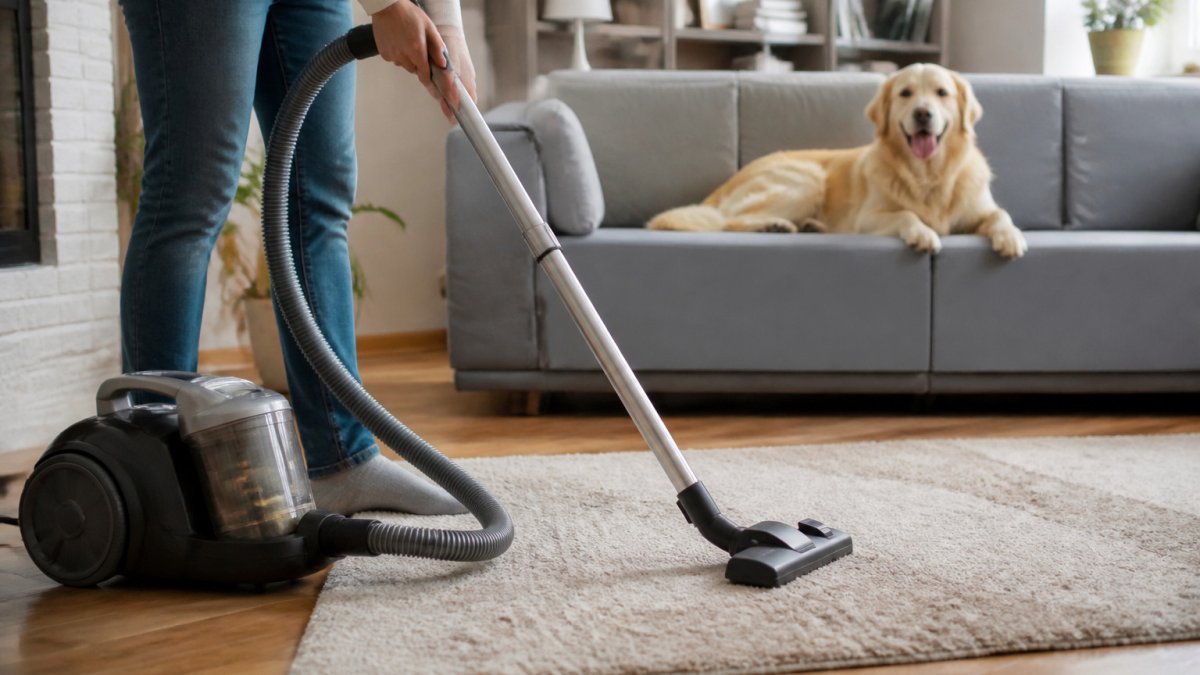
!A homeowner vacuuming pet hair off a living room rug with a dog resting nearby on the sofa
A strong option for pet owners is the Riccar R27P Clean Air Premium Pet Upright Vacuum, which pairs pet-focused cleaning with HEPA filtration and a dust and allergen sensor. For a broader look at pet-hair picks on hard floors, see our guide to best vacuums for pet hair on hardwood floors. If your home is mostly carpet, our best vacuum for dog hair on carpet roundup covers tested models for that use case.

Watch out: Pet hair can clog brush rolls quickly. Check the brush area every week, not every month.
A true HEPA filter is necessary but not sufficient. The filter can only trap particles that reach it, and the assembled vacuum can leak around gaskets, seams, and the bin. This is the step most buying guides skip, and it is the difference between a HEPA label and a HEPA-performing machine.
Air follows the path of least resistance. If the housing, bin seal, or exhaust gasket is loose, dirty air can bypass the filter and return to the room. A sealed system is designed to route the air path from the cleaning head to the exhaust through the filter. Look for language such as "sealed system," "fully sealed," or "HEPA-sealed" and ask whether the seal covers the bin, the motor housing, and the exhaust.
Filter efficiency alone does not show how clean the exhaust air is. When you compare models, look for:
If a manufacturer only publishes a filter efficiency number and never addresses the assembled machine, treat the HEPA claim as unverified.
A HEPA filter in an unsealed vacuum can perform worse in the room than a well-sealed vacuum with a slightly lower-rated filter. Judge the whole machine, not the filter alone.
True HEPA is generally defined as capturing at least 99.97% of particles at 0.3 microns. That number is a filter-level benchmark, not a promise about your room. It does not account for leaks, worn gaskets, or a full bin. It also does not mean the vacuum captures 99.97% of all particles of every size; capture efficiency varies by particle size and by how well the filter is seated.
Purchase price is only the first payment. Replacement filters, bags, belts, and brush rolls add up, and hard-to-find parts can shorten a vacuum's useful life. Build a simple annual cost estimate:
A machine with a lower purchase price but a costly, proprietary filter can cost more over five years than a higher-priced model with widely available consumables. Ask the retailer to price a full year of filters and bags before you decide.
Before buying, confirm three things: the replacement filter is currently in stock, the part number is published, and the manufacturer has a track record of supporting the model. Washable pre-motor filters reduce consumable cost but do not replace the HEPA filter. Reusable bags cut bag cost but must be emptied carefully to avoid releasing the particles you just captured.
Choosing a HEPA vacuum is easier with expert help. Vacuums Unlimited offers expert, personalized advice to help you choose a vacuum, and you can shop online or visit the store to compare machines in person. Genuine parts, filters and bags are available through our online store.
Start with the filter itself. Look for a true HEPA filter rated to capture at least 99.97 percent of particles at 0.3 microns, and confirm the manufacturer states this in the product specifications rather than vague wording like HEPA-style or HEPA-type. Next, check whether the machine is a sealed system, because a good filter loses value if dust leaks out through gaps, hoses or the bag housing. Finally, consider how you will use it: floor types, pet hair, cord length and the cost of replacement filters and bags over time. Compare these details across models before you buy, and ask a retailer to demonstrate the machine on your own floors.
For many allergy sufferers, yes. A true HEPA filter captures very fine particles such as dust mite debris, pet dander and pollen that standard filters let back into the air. Vacuums capture the particles that settle on floors, carpets and upholstery, so the filter and sealed design matter as much as suction. A HEPA vacuum will not remove everything in the air by itself, so pairing it with regular cleaning, bedding care and, where needed, a standalone air purifier can make a bigger difference. If symptoms are severe, consult a healthcare provider.
The main difference is the filter. A regular vacuum typically uses a basic filter that traps larger debris but allows many fine particles to pass through the exhaust. A true HEPA vacuum uses a high-efficiency filter that captures at least 99.97 percent of particles at 0.3 microns. Suction and brush design also matter, so a HEPA vacuum is not automatically better at cleaning. The real test is whether the whole machine is sealed, so the filtered air is the only air leaving the unit.
Yes, when the machine is designed for pet hair. Look for a strong brush roll, a tangle-resistant design, and a bag or bin you can empty easily. Upright models with a motorized brush are often most effective on carpet and rugs, while canister models with a turbo tool can work well on upholstery and stairs. Check how the vacuum handles hair wrapping around the brush, and plan to clean the brush roll regularly to keep suction strong.
