

Do I Need a HEPA Air Purifier? A 2026 Guide
, by Editorial Team, 15 min reading time
, by Editorial Team, 15 min reading time
Do I need a HEPA air purifier? Learn who benefits most, how to size one by room, and when a vacuum or HVAC filter is the better first step.
Last Updated: October 21, 2026
If you wake up congested, sneeze through spring, or watch dust settle on furniture hours after cleaning, a HEPA air purifier may help, and the answer depends on what is actually floating in your air. A HEPA air purifier is a freestanding appliance that pulls room air through a high-efficiency particulate air filter to capture particles as small as 0.3 microns at 99.97% efficiency. At Vacuums Unlimited, we talk with allergy sufferers and pet owners every week who ask this exact question, and the honest answer starts with your symptoms, not a product page.
Below, we'll walk through the signs that justify a unit, who can skip one, and how to size it correctly.
Seven signals separate a genuine need from a nice-to-have. Work through this list honestly before you spend anything:
Two or more of these, and an air purifier is worth considering. One occasional symptom usually is not.
Most guides answer this with a list of symptoms.
1. Is there an identifiable source you can remove or seal? If yes, do that first.
2. Is the problem particles or gases? HEPA filtration is a particle tool. It captures dust, pollen, pet dander, mold spores, and combustion particles.
3. Are symptoms room-specific or house-wide? Morning congestion that clears when you leave the bedroom points to a single-room problem, and a properly sized HEPA unit in that room is a reasonable buy.
4. Do you have good ventilation already? A home with working exhaust fans, open windows in season, and no pets, smoking, or dampness rarely needs a standalone purifier.
5. Is anyone in the home in a higher-risk group? People with allergic rhinitis, mild asthma, or respiratory sensitivity, and households with infants or older adults, have a stronger case.
A simple rule: if you answered yes to a removable source in question 1, fix that first. If the problem is particles, room-specific, and ventilation is limited, a HEPA purifier is worth buying.
For allergy sufferers, a HEPA purifier reduces exposure to pollen, dust, dust mites, pet dander, and mold spores in the room where it runs. That reduction can ease respiratory symptoms for people with hay fever and mild asthma, particularly overnight in a bedroom.
What it cannot do is eliminate allergens from surfaces, upholstery, or carpet. Filtration handles what is airborne in one room, not what has settled. This is where a vacuum with genuine HEPA filtration matters just as much: it removes the reservoir of dust and dander that keeps feeding the air. If you are coming from a cheap vacuum that leaks fine dust back out, the purifier is fighting a losing battle.
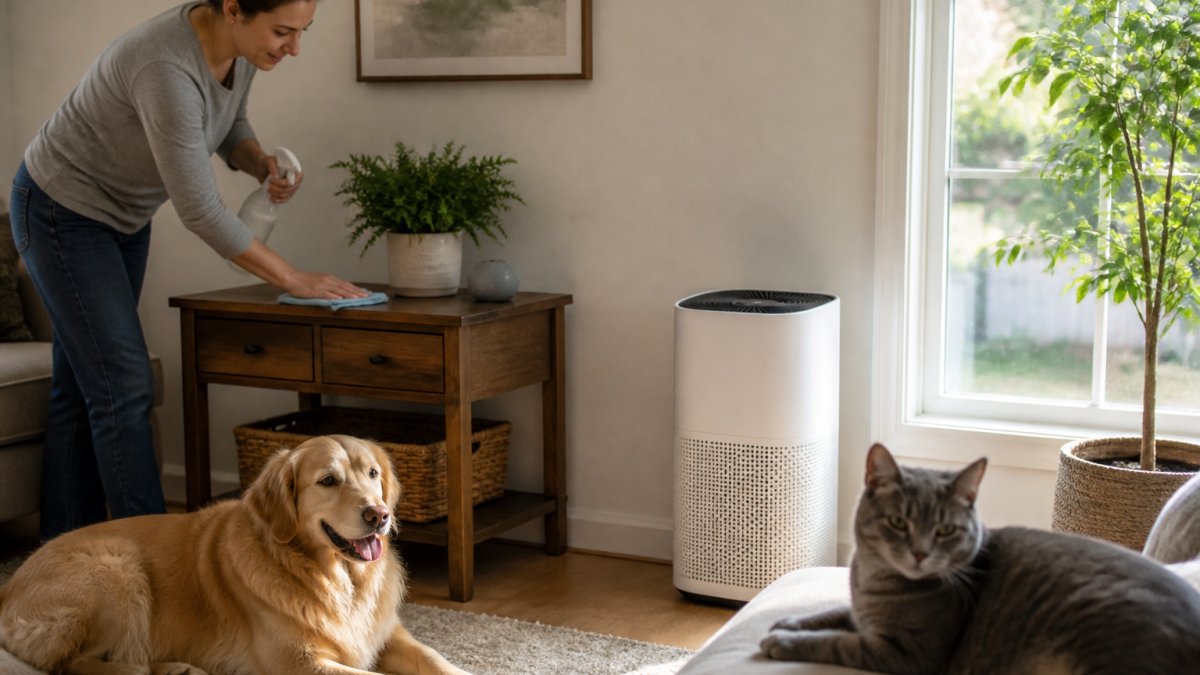
Sizing comes down to matching a unit's clean air delivery rate to your room volume, and you can do it in three steps.
Step 1: Measure the room. Multiply length by width by ceiling height in feet to get cubic feet. A 12 x 15 foot room with 8-foot ceilings is 1,440 cubic feet.
Step 2: Find the CADR. Clean air delivery rate is listed in cubic feet per minute (CFM). A unit rated at 200 CFM delivers 12,000 cubic feet of clean air per hour.
Step 3: Check air changes per hour. Divide hourly clean air delivery by room volume. At 12,000 divided by 1,440, you get roughly 8 air changes per hour, which suits a bedroom. Aim for 4 to 5 in living areas and 5 or more in bedrooms.
| Room Type | Target Air Changes/Hour | Notes |
|---|---|---|
| Bedroom | 5+ | Run overnight for allergy relief |
| Living room | 4-5 | Higher if pets or traffic nearby |
| Home office | 4-5 | Match to occupancy |
| Kitchen-adjacent | 6+ | Cooking smoke and odors |
Be skeptical of "covers up to X square feet" claims. They usually assume an 8-foot ceiling and a low air-change target. Do the math yourself.
Source control beats filtration every time, and filtration beats nothing. But the more useful question is which method handles which pollutant. The table below compares what each approach can and cannot address.
Austin Air Healthmate Junior Purifier (Sandstone) →
| Approach | Handles well | Does not handle | Best use |
|---|---|---|---|
| Source control | Dust, dander, mold spores, smoke, chemical fumes at the origin | Nothing airborne already in the room | Always first; lowest cost, highest impact |
| Portable HEPA purifier | Airborne dust, pollen, pet dander, mold spores, combustion particles in one room | Gases, odors, carbon dioxide, carbon monoxide | Room-specific particle problems, especially bedrooms |
| HVAC filter (MERV 13) | Particles across the whole house while the fan runs | Gases unless paired with carbon media; nothing when the fan is off | House-wide particle reduction with central air |
| Activated carbon media | Odors, some volatile organic compounds, some gases | Particles; carbon dioxide | Chemical and odor problems, often as a second stage |
Source control means removing or sealing what produces pollutants: fixing leaks, encasing mattresses, keeping pets out of bedrooms, venting the range hood outdoors, and banning indoor smoking.
Portable HEPA purifiers are particle tools. A true HEPA filter captures 99.97% of particles at 0.3 microns, which covers dust, pollen, dander, mold spores, and most smoke particles.
HVAC filters work across the whole house, but only while the system fan runs.
Activated carbon media is the option for gases and odors. It is often sold as a second filtration stage in purifiers, and it is the right choice when the complaint is chemical smells, cooking odors, or fumes rather than particles.
A practical decision tree: if symptoms are room-specific and particle-related, buy a HEPA unit for that room. If they are house-wide and you have central air, start with a better HVAC filter and sealed ducts.
Run your purifier on high for an hour before bed, then drop it to low or medium overnight. Most units are far quieter at lower speeds, and the room's particle count stays low once you have cleared it.
No, you cannot wash a true HEPA filter. Water damages the fine fiber media and destroys the seal, and a washed filter loses its rated efficiency. Vacuum the outer pre-filter monthly with a brush attachment, and replace the HEPA media on the schedule the manufacturer specifies, typically every 12 to 18 months in continuous use.
Budget for total cost of ownership, not just the sticker price. Replacement filters vary widely, and hard-to-find media can turn a bargain unit into a paperweight. Before buying, confirm the filter is stocked and affordable, and check availability years down the line. At Vacuums Unlimited, we stock genuine filters and parts for the brands we carry, so you are not hunting for a discontinued cartridge.
Pros:
Cons:
Set realistic expectations. A purifier reduces exposure; it does not cure allergies or asthma. Pair it with source control and a HEPA-filtered vacuum, and the combination does more than either alone. For readers who want a unit that also handles chemicals, gases, and odors, the Austin Air HealthMate Junior at $795 pairs a true HEPA stage with over 270 cubic inches of activated carbon and zeolite, sized for smaller spaces. The full-size Austin Air HealthMate at $715 adds more carbon media and a larger HEPA stage for bigger rooms.

Not always. A vacuum with a sealed HEPA filter removes dust, pet dander, and dust mites from carpets and upholstery at the source, which is where most allergens settle. An air purifier only helps with particles that are already airborne. If your symptoms are mild and your vacuum is sealed and well-maintained, start with better vacuuming and ventilation. Add a HEPA air purifier if you still notice symptoms in a specific room, especially a bedroom where you spend 7-8 hours a night.
People with diagnosed allergies or asthma, pet owners, and anyone living near a busy road or in a home with visible mold benefit most. A HEPA air purifier for allergies helps because it captures pollen, pet dander, dust mites, and mold spores down to 0.3 microns at 99.97% efficiency. Smokers and households with wildfire smoke also see value. If nobody in the home has symptoms and ventilation is good, an air purifier is optional rather than necessary.
Use the CADR rating and the 2/3 rule: choose a unit whose CADR in cubic feet per minute is at least two-thirds of the room's floor area in square feet. A 300 sq ft bedroom needs a CADR of about 200 CFM. For higher air changes per hour, size up. The Austin Air HealthMate, for example, is built for larger open rooms, while the HealthMate Junior suits smaller spaces. Measure your room before buying.
Most true HEPA filters cannot be washed. Rinsing them damages the dense fiber media and drops efficiency below the 99.97% claim. Some units have a washable pre-filter, which you can rinse monthly, but the HEPA stage itself is replaced. Check the manual: if it says 'permanent' or 'washable HEPA,' follow the brand's exact instructions. For standard HEPA, plan on a replacement every 12 to 18 months, or sooner in pet homes.
Not on its own. HEPA media captures particles, not gases. Odors, cooking fumes, and volatile organic compounds need activated carbon or zeolite. Units like the Austin Air HealthMate include over 780 cubic inches of activated carbon and zeolite alongside true medical-grade HEPA, so they address both particles and gases. Carbon dioxide from breathing is not removed by any typical residential purifier; that requires ventilation.
They can reduce exposure to airborne allergens and fine particulate matter in a nursery, which is reasonable if the room has carpet, pets, or poor ventilation. Choose a unit with a true HEPA filter, low noise on its sleep setting, and no ozone generation. Keep the unit out of reach and secure the cord. An air purifier supports a healthy room but does not replace cleaning, ventilation, or medical advice for a child with respiratory symptoms.
Still sneezing after you have addressed the obvious sources? The right purifier, matched to your room and your symptoms, makes a measurable difference. Vacuums Unlimited carries genuine filters and parts, offers expert guidance to match a unit to your needs, and supports every purchase with professional service. Get started with Vacuums Unlimited and breathe easier in the rooms that matter most.